Desired Outcomes
Overview:
Sometimes referred to as the client’s ‘best hopes’, solution focused conversations prioritize discovering what the client wants to achieve as a result of our work with them. This might be different from what professionals want, or what we think is best for them; it is the outcome that the client themselves considers most important.
Purpose:
Acquiring a client’s desired outcomes/best hopes carries multiple benefits:
- It builds good working rapport (as the client feels heard)
- Improves time-efficiency as you have a common understanding of where you’re heading
- Gives you something to build towards (rather than a problem to fix)
Example questions:
- What are your best hopes from our work together?
- What would tell you that this meeting had been worthwhile?
- How would you know that our visit today had been a helpful one?
- Suppose our conversation turned out to be useful somehow, how would you know?
- What would need to be happening in a few months’ time, for you to be able to look back and think, “those meetings/visits were productive after all”?
More often than not, it is advised to follow the client’s answer by asking: “And what difference would that make?”
If the client provides you with a negatively phrased answer (e.g., “I don’t want to be so depressed all the time”), then you can respond with an ‘instead’ question like: “And what would you hope to be instead?”
Example conversation:
Professional: Thank you for making time for us today. To begin with, I’d like to ask, what are your best hopes from our work together?
Client: I’m not sure.
P: That’s okay. If our visit and conversation today turned out to be helpful somehow, how would you know?
C: I guess I’d be a bit clearer on why I’m being dragged to these meetings and what’s expected of me.
P: Okay, and what difference will having greater clarity and understanding make?
C: I suppose I’d be able to think more clearly and not feel so angry all the time.
P: Sure, and if that happened, what would you feel instead of anger?
C: Not sure. Maybe I’d be a little bit calmer.
P: Okay, so if, as a result of our talking together today, you were able to think more clearly, with greater clarity and a sense of calm, would that show our meeting had been a good use of time?
C: Yes.
Key thing to remember:
A client’s desired outcomes/best hopes are most effective when they are:
- Positively phrased
- Something that the client genuinely wants
- Something that fits the worker’s legitimate remit (e.g., we can’t help them win the lottery!)
Instances of Success (Existing Resources)
Overview:
This component is commonly misunderstood as ‘strengths-based’ working, but the instances of success in Solution Focused practice are different in a couple of ways:
- Any resources/strengths/instances of success that we highlight will ideally be linked in some way to the client’s desired outcomes (which helps to focus our efforts).
- The questions are designed to go beyond simple acknowledgment and praise. Our intention is to highlight and amplify existing resources in a way that boosts the client’s self-belief and confidence, leaving them feeling more able to achieve their desired outcomes.
Purpose:
As mentioned above, the purpose of this component is to raise the client’s confidence levels. To give them the belief that their desired outcomes aren’t as far out of reach as they might seem, and that they can be achieved if the client puts their mind to it.
Example Questions:
- When was the last time you were [insert desired outcomes]?
- When in the last week did you manage that, even in a small way?
- What’s been better since I last saw you?
- What have you been most proud of since our last visit?
- What are three things you’ve been pleased with in the last few weeks?
Then, once we have identified an ‘instance of success’, our job is to amplify it with questions like:
- How did you manage that?
- What did it take?
- What else did you do to help make that happen?
- What skills and abilities of yours did you have to draw upon?
- What sort of effort did it require?
- What does that achievement show about the person that you are and can be?
- What does it tell us about your values and potential?
Example Conversation:
P: When was the last time you felt like you were being a good parent, the sort of father you want to be?
C: Well, last week I did help my son with his homework, even though it was late at night and I was tired.
P: Okay, how did you manage to help your son with his homework even though you were tired?
C: Well, I didn’t really understand it to be honest, but I listened as he explained it to me and then we googled the answer together.
P: And what else pleased you about the way you helped your son with his homework on that occasion?
C: Hmm… I guess it helped that I turned off what I was watching on the TV, so that I could give him my full attention.
P: I see, so when your son asked for help you switched off the TV so you could give him your full attention, and even though you didn’t understand the homework yourself, you were able to listen and help him search for the answer. I’m curious, what do you think that shows about the sort of parent you are and can be?
C: Maybe that I can be patient with him, even on the days that I’m tired.
Key thing to remember:
In Solution Focused work, it’s important that we go beyond acknowledgment and praise. In practice, this means taking time to ask questions like “how did you manage on that occasion?” and “what efforts did that take?”, rather than simply saying “well done” or “great job”.
Preferred Futures
Overview:
Preferred futures are descriptions of what the client’s life would be like were their desired outcomes achieved. We use little words like ‘if’, ‘suppose’, and ‘imagine’, to invite the client to think ahead into the future; we ask them to envisage a version of their life where their hopes and desired outcomes are reality, and to describe to us what this new reality would be, feel, and look like.
Purpose:
There are multiple reasons for inviting clients to envisage and describe their preferred futures. The main one, in my experience, seems to be the positive impact these conversations can have on people’s level of motivation to make changes in their lives. Having pictured, described, and in some way experienced for a moment what their life/preferred future could be like, many clients find themselves with a renewed desire and motivation to make moves towards making it happen.
Example Questions:
Start with something like…
- Let’s suppose that starting tomorrow, you do become [insert desired outcomes], what will be the first sign tomorrow morning that something’s changed?
- If you somehow manage to achieve [insert desired outcome], where will you notice that most?
- Let’s imagine for a moment that you do reach [insert desired outcomes], what will that look like?
- Suppose that over the coming weeks your [insert desired outcomes] do come true, how will you know?
Then build description with short, simple questions like…
- What would be another sign that your hope/desired outcome has come true?
- What would you notice about yourself?
- What would other people notice about you?
- What would you be doing differently?
- What would your next appointment/commute/family meal-time/bedtime routine look like if your hopes/desired outcomes were present?
- How will your [insert desired outcome] show? (e.g., how will your clarity of thought and sense of calm show itself when you’re at that meeting next week?)
- How will other people react to seeing you [insert desired outcomes]?
- How will you respond to their reaction?
- What difference will that make?
Example Conversation:
P: Thank you for answering all my questions so far, I’m wondering, suppose that somehow your hopes do come true… So, you become more confident and assertive… where will you notice that the most do you think?
C: No problem. And maybe in my meetings with your lot, because I always feel like I get talked over by professionals, and also when I’m putting the kids to bed, which as you know has been a nightmare for us.
P: Alright, and is it ok if I ask you a couple of questions about both of those areas?
C: Sure.
P: Ok, so next time you’re in a meeting with professionals, what will be a sign that you’re more confident and assertive?
C: I’ll actually say what I’m thinking and voice my opinion rather than just sulking in silence.
P: What will you notice about the way you voice your thoughts and opinions that shows you’re doing so with confidence and assertiveness?
C: I’ll think carefully about what I want to say and make sure the most important parts are heard by everyone.
P: I see, and what difference will that make to the meeting?
C: I guess people will have a better understanding of where I’m coming from, and I’ll have actually let out and verbalised some of my frustration.
P: Sure, and how might that be good both for yourself and also the professionals in the room?
C: Well, they will probably be shocked to begin with, but I’d hope it would lead to a more productive conversation in the long run.
P: Ok, thank you. Now you also mentioned you would notice your renewed confidence and assertiveness when you’re putting the kids to bed. So, what would the kids notice about you during bedtime that told them you were being confident and assertive?
C: That I actually mean what I say! That I stick to the rules I’ve set for them.
P: And how will you know you’re sticking to the rules you’ve set?
C: They’ll have to stop gaming at 10:30, and if they refuse I’ll switch the internet off.
P: Alright, and how will the kids react to you sticking by the rules you’ve set?
C: They’ll be really upset and moody; probably start screaming about how unfair it is.
P: I see, so how will you know that you’re still being confident and assertive, even if the kids are upset and screaming.
C: I’ll remind myself that they’ll get bored and tired eventually and stay calm.
P: How will you know that you’re staying calm?
C: I won’t respond to the complaints and screaming, I’ll just switch off the internet and say, “this is what was agreed”.
P: And on this day, when you’re confident, assertive, sticking to the rules you’ve set, and staying calm even if the kids scream, what will you be most pleased to notice about yourself?
C: That I’m taking some control of the situation.
Key thing to remember:
The most common mistake made by professionals learning to hold ‘preferred future’ conversations is to get drawn into steps and action planning (e.g., “what do you need to do to reach your desired outcomes?”). Preferred future conversations deliberately skip over action planning and steps and go straight to imagining that the desired outcomes have already been achieved, and to the signs of that having happened.
Below are a few examples to show the distinction:
| Is this a Solution Focused question? | |
|---|---|
| No | Yes |
| What do you need to do to reach your desired outcome? | Suppose that somehow you do reach your desired outcome, how will you know? |
| What steps do you need to take to achieve your desired outcomes? | If you do manage to achieve your desired outcomes, what will be the first sign that you have done? |
| What actions do we need to take between now and the next meeting? | Let’s imagine for a moment that between now and our next meeting your hopes/desired outcomes start to come true, what are 3 things that you’ll be doing differently? |
Solution Focused Scales
Key thing to remember:
A Solution Focused scale is one of the tools that can be used to bring a little bit of
each core element into a conversation.
Using the Solution Focused Scale
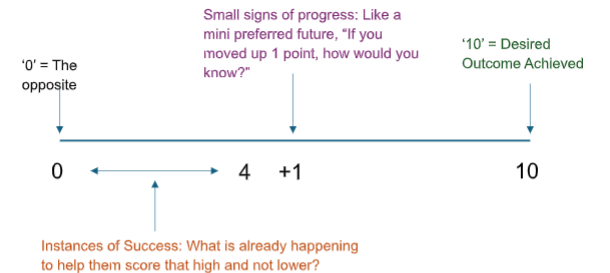
As you can see from the diagram above, the ‘Desired Outcome’ is placed at the top of the scale, the ‘instances of success’ can be found in the space between 0 and the score that the client gives for their current position (e.g., ‘4’ in the example), and ‘preferred future’ questions are utilised when asking the client to consider small signs of progress—moving up the scale by one small point.
Example Questions
Setting up the scale
- Imagine a scale from 0 to 10, where ‘10’ represents your desired outcomes/best hopes and ‘0’ the opposite.
Where would you place yourself on that scale currently?
Searching for instances of success
- What’s helping to keep you that high on the scale rather than being down at the bottom?
(Prompt with “What else?” up to 5 times)
Then amplify each answer with questions like…
- How have you managed that?
- What efforts has it taken?
- What does it show about the person that you are and can be?
Signs of progress (a mini preferred future conversation)
- Suppose that you manage to make some steady progress, and move up one small point on the scale,
what will be a sign that shows you’ve reached one point higher on the scale? - What else would be a sign?
- What will you be doing differently?
- What would you notice about yourself?
- What would others notice about you?
- Etc.
Scale Summary (Visual Concept)
10 ← Desired Outcome Achieved
0 ← The Opposite
???? Small signs of progress:
Like a mini preferred future
“If you moved up 1 point, how would you know?”
???? Instances of Success:
What is already happening to help them score that high and not lower?
(e.g., score of 4 → aiming for +1)
Queries
If you have any questions or queries regarding the above information, feel free to email us at: